


 Tiếng Việt
 Overview

Developing Bond Yield Curves and Pricing Infrastructure - Key Drivers for Vietnam’s Bond Market
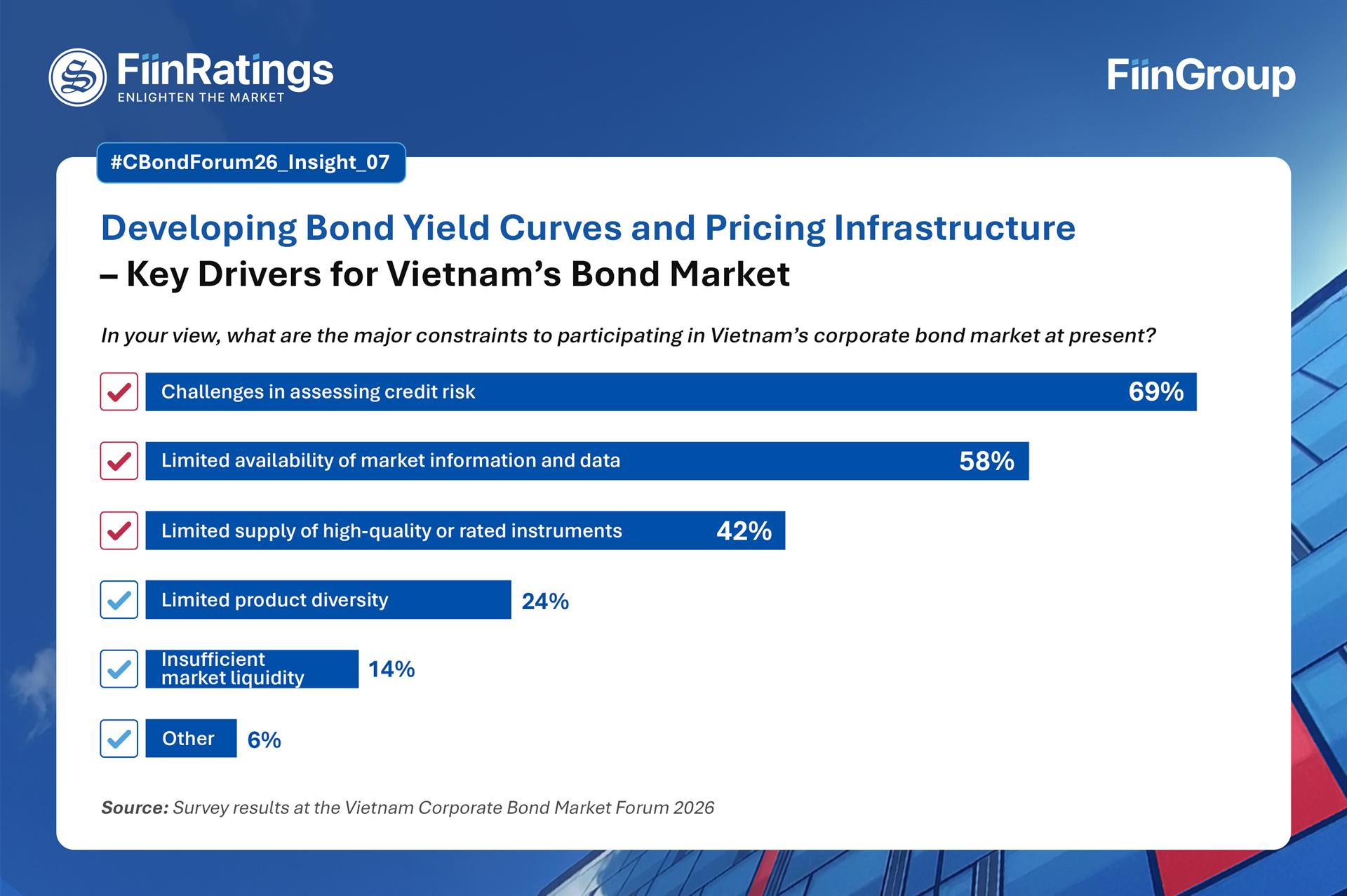
Vietnam’s corporate bond market has recorded a significant recovery in scale, with the outstanding value of corporate bonds reaching nearly VND 1,400 trillion. However, expansion in market size does not mean a stronger capacity to attract medium- and long-term capital flows, as market-based pricing benchmarks remain underdeveloped.
The absence of a benchmark yield curve and standardized pricing infrastructure makes it difficult to assess funding costs and credit risk consistently across market participants. This not only heightens the risk of “delayed pricing” amid interest rate volatility but also has a direct impact on market transparency and institutional investor participation.
Commentary No. 07 from the Vietnam Corporate Bond Market Forum 2026 examines the structural limitations in market data infrastructure, pricing mechanisms, and credit risk assessment frameworks, thereby highlighting the prerequisites for strengthening investor confidence and enhancing the market’s capital allocation efficiency.
Key Highlights:
🔹 Recovery in scale, but lacking market depth: Vietnam’s corporate bond market is recovering in scale, but still lacks depth, limiting its role as a medium- to long-term funding channel and reducing its appeal to institutional investors.
🔹 Pricing infrastructure remains a structural bottleneck: The absence of a benchmark yield curve and standardized pricing infrastructure remains a key structural constraint, leading to fragmented pricing, inconsistencies across institutions, and heightened risk of “delayed pricing” amid interest rate volatility.
🔹 Urgent need for a robust credit rating framework: Survey findings from the Forum indicate that difficulties in assessing credit risk represent the largest constraint for investors. This underscores the need for a robust credit rating framework as a foundation for risk standardization and for the development of credit spreads and the yield curve.
🔹 Three pillars for secondary market development: Improving secondary market liquidity requires a coordinated and systematic approach centered on three pillars: data transparency, pricing infrastructure, and investment products. In this process, AI and digital transformation can act as key enablers to standardize data, automate processes, and enhance capital allocation efficiency among investment funds, thereby improving liquidity and strengthening investor confidence.
The analyses and views presented in this report are consolidated from the insights shared by speakers at the Vietnam Corporate Bond Market Forum 2026, co-hosted by FiinRatings, FiinGroup, and S&P Global Ratings in Hanoi on April 2,2026
👉 Access the full commentary at: THIS LINK
🔔 Follow FiinGroup and FiinRatingsfor further insights and analysis from the Vietnam Corporate Bond Market Forum.
--------------------
💎 Discover FiinGroup’s financial data and analytics solutions: https://fiingroup.vn/
💎 Explore FiinRatings’ services supporting investors and issuers: https://fiinratings.vn/
Tags: Vietnam Bond Market , Market Commentary , Credit Ratings


